
Data problem? No. You have a decisioning problem.
We had a strong turnout for our recent webinar on personalisation and decisioning - and the conversation was worth it.
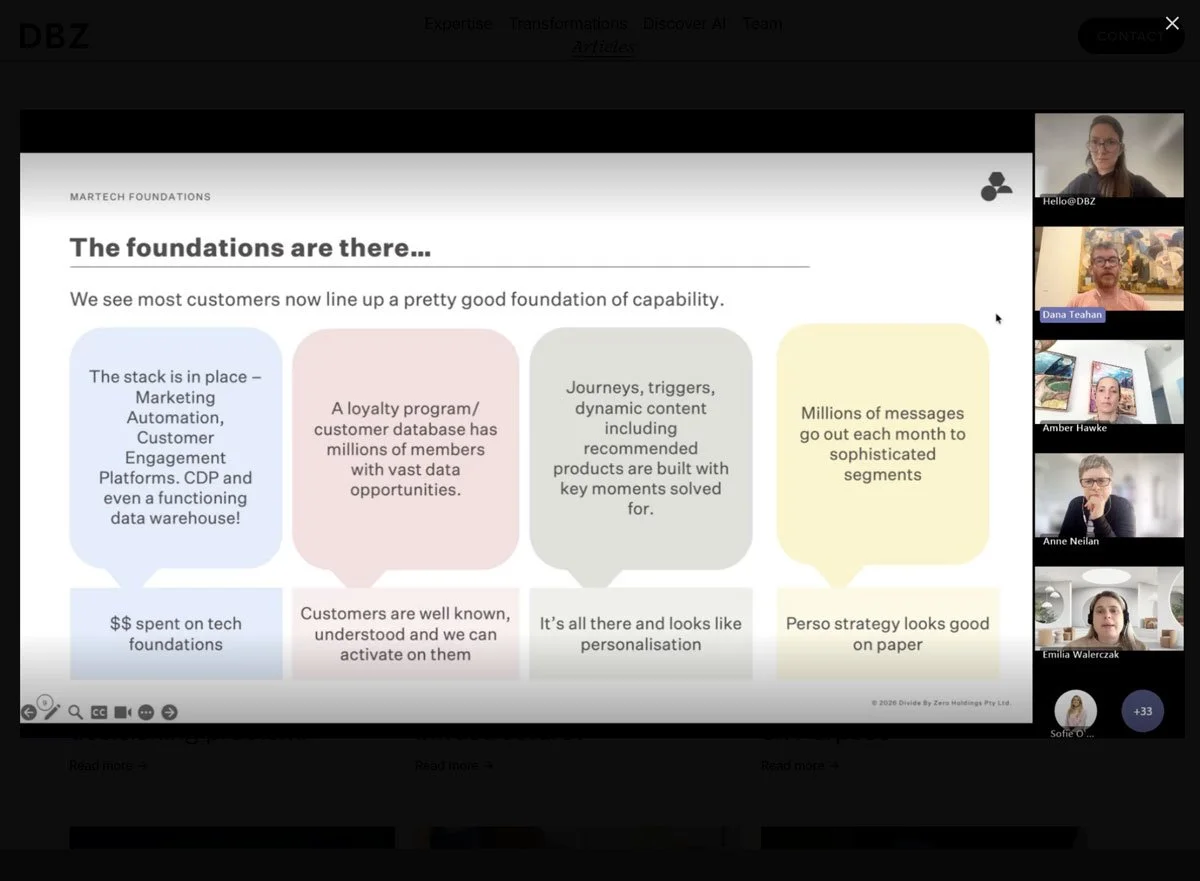
The headline insight: most organisations don't have a data problem. They have a decisioning problem. The data is there. The loyalty program is there. The MarTech stack is there. What's missing is the logic to turn all of it into timely, individual decisions - not segment-level assumptions, but per-customer calls made in the right moment.
We covered where personalisation actually moves the needle (high-intent moments, onboarding, lapsing customers), why segmentation and personalisation aren't the same thing, and why agentic AI is changing what's possible in complex environments like retail.
If you weren’t able to attend, here is the detailed recap:
Decisioning Not Data
Every team we sit down with thinks they have a data problem. Some do, most don't. Most organisations we work with already have decent data foundations, a loyalty program collecting transaction history, and a Martech stack that's more than capable of personalisation at scale. What's missing isn't the data. It's the logic to turn that data into a decision, for each customer, right now.
The pattern that came up again and again was the same one we see in almost every engagement: the infrastructure is there, the intent is there, and the thing standing between the two is a decision layer nobody's built yet.
Segments aren't people
We think this is the gap most teams don't see until it's pointed out. Sending one message to a thousand people who share an attribute is sophisticated batch marketing. It is not personalisation, no matter how clever the segmentation logic behind it is. Real personalisation means a decision made for one customer, not a decision made for a bucket of customers who happen to look similar in a database.
The two get confused constantly, partly because segmentation feels like progress. You go from blasting everyone the same offer to splitting your base into ten groups, and it genuinely is better. But it's still a guess applied at scale, just a more educated one. The question worth asking in your own program is simple: when this message goes out, is it going to the same group every time it's sent, or is the decision actually being re-made per person, per moment? If it's the former, you're doing very good batch marketing. That's a fine thing to be doing. It's just not one-to-one.
Effort Where It Counts
What we'd say to any team trying to fix this is: stop trying to personalise everything at once. Some interactions barely move the needle no matter how individualised they are. The moments that do are usually high intent (cart, search, browse behaviour), onboarding, and customers showing early signs of lapsing. These are the moments where a sharper decision changes a commercial outcome. Concentrate there first.
Why It Was Hard
Retail and other complex verticals have struggled with decisioning for years, and for a reasonable reason. Too many products, too many customers, too many edge cases, and human-written rules simply couldn't scale fast enough. You can hand-write a rule for your top twenty scenarios. You cannot hand-write one for the long tail of edge cases that make up the bulk of real customer behaviour, and most teams we work with knew that and made peace with it years ago, which is part of why decisioning quietly dropped off the roadmap.
What's changed is that agentic AI can now reason through that complexity itself and handle the edge cases without every single scenario being mapped out in advance. That's the change that wasn't available even two or three years ago, and it's the reason decisioning is back on the table for verticals that had quietly given up on it. We'd be cautious about overclaiming here. It's not magic, and it doesn't remove the need for a clear value exchange and clean inputs. But it does remove the excuse that complexity makes decisioning impractical.
Three Shifts To Start
We'd frame the shift in three parts. From a campaign calendar to a continuous decisioning engine. From segments to individual-level decisions. From channel silos to a single orchestration layer that coordinates every touchpoint, rather than email, SMS and app all quietly making their own call about what the customer sees next.
None of that means rebuilding the stack. Start smaller. Find the five to ten moments in your customer journey where someone is still making a manual call that could be automated, and work through those first. The mechanics will follow once you know which decisions actually matter.
In reality, the data was never really the constraint. The constraint was always whether you had a way to act on it, one customer at a time, fast enough to matter. Start with the moments, not the platform.
Download the pack here.
If you missed the session, or want to talk through what this looks like for your team specifically, reach out to Sofie at sofie.omara@dividebyzero.com.au