
Renew, Retune or Replace?
A successful martech RFP isn't just about choosing the right platform. It's about understanding what your organisation really needs, evaluating the options objectively and making a decision that delivers long-term value.
When a martech platform approaches renewal, it's tempting to see the decision as a choice between staying with your current provider or finding something new. But there's often a third option worth considering: getting more out of the technology you already have.
In our recent webinar, Renew, Retune or Replace?, we explored how organisations can approach martech RFPs with greater clarity, objectivity and confidence. Drawing on Divide By Zero's experience supporting more than 100 RFP processes, we shared practical lessons on what makes a successful selection process, where organisations commonly go wrong and why the best outcome doesn't always involve buying new technology.
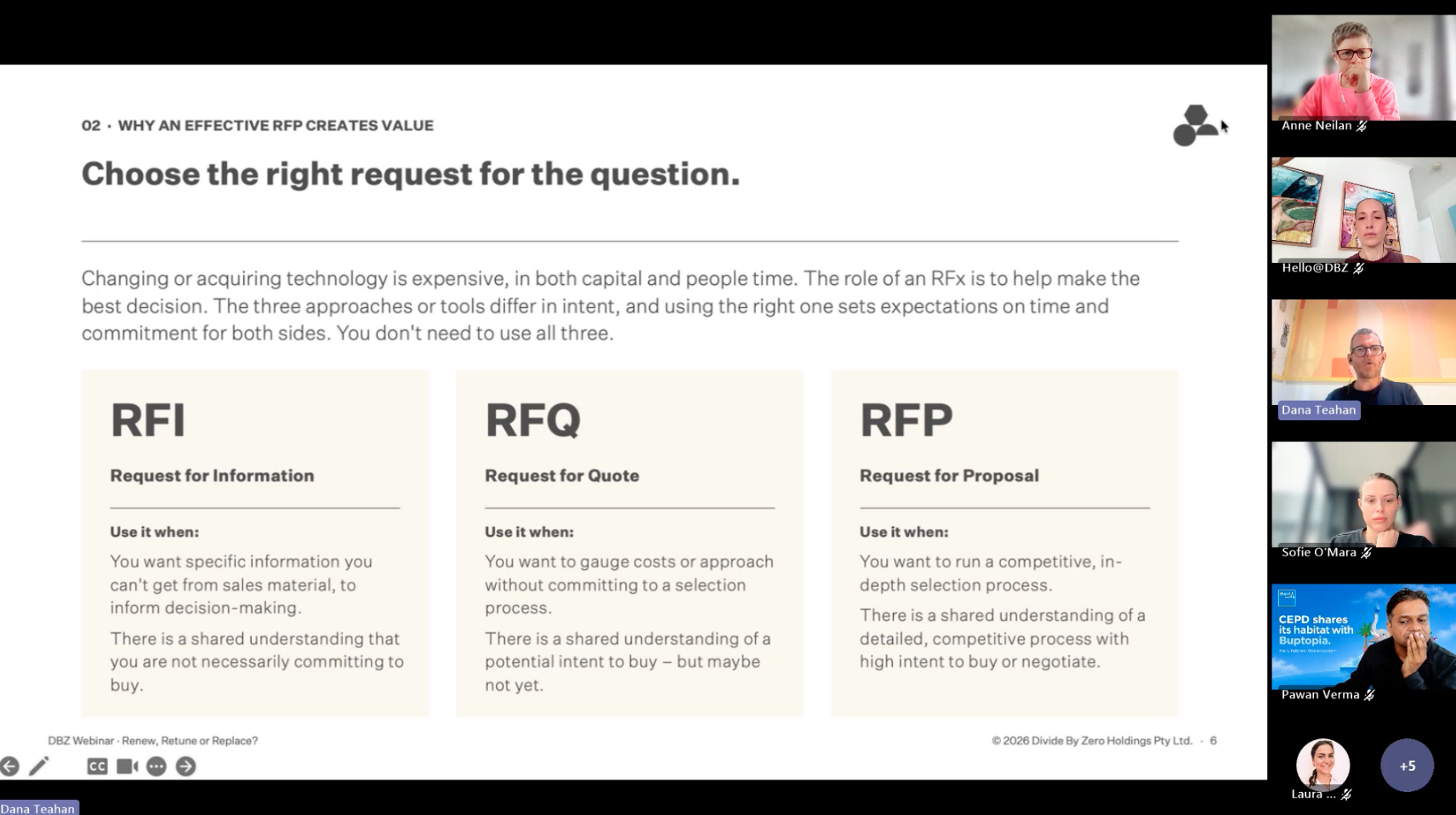
If you weren’t able to attend, here is the detailed recap:
1. Start Early, Not When Your Contract is About to Expire
One of the most common mistakes organisations make is leaving their martech review too late. Ideally, planning should begin 12 to 18 months before renewal, allowing enough time to assess current performance, align stakeholders, explore the market and, if necessary, transition to a new platform. Leaving it until the final few months can limit your options and weaken your negotiating position.
It's also important to involve the right people from the beginning. Customer, Marketing, IT, Data and Procurement all bring different priorities and perspectives to the decision, and getting agreement on business outcomes, trade-offs and decision-making responsibilities early makes the process more effective and reduces the risk of surprises later.
2. Define the Outcome Before the Requirements
A long list of features doesn't necessarily make a good RFP. In fact, one of the biggest challenges we see is organisations developing hundreds of requirements without clearly defining what they're trying to achieve. This can result in a process where every vendor appears to meet the requirements, making it difficult to identify meaningful differences between solutions.
Instead of asking whether a platform has a particular feature, focus on what your team actually needs to do. For example, rather than asking whether a platform has a journey builder, ask vendors to demonstrate how a marketer would create and launch a cross-channel customer journey. This shifts the conversation from features to real-world capability and provides a much clearer picture of how a platform would work in practice.
It's also important to distinguish between what is essential today, what genuinely differentiates vendors and what might be useful in the future. A strong RFP compares outcomes and trade-offs, not feature counts.
3. Look Beyond the Vendor Demo
What we'd say to any team trying to fix this is: stop trying to personalise everything at once. Some interactions barely move the needle no matter how individualised they are. The moments that do are usually high intent (cart, search, browse behaviour), onboarding, and customers showing early signs of lapsing. These are the moments where a sharper decision changes a commercial outcome. Concentrate there first.
4. Consider the Total Cost, Not Just the Licence Fee
The cheapest platform on paper isn't always the most cost-effective decision. Licence fees are only one part of the investment, with implementation, integration, migration, training, internal resources, ongoing support and eventual exit costs all contributing to the total cost of ownership.
Organisations should assess these costs over a longer period, ideally five years, rather than making decisions based on the initial commercial proposal. It's also worth looking carefully at pricing models, potential usage increases, AI consumption charges and what happens when introductory discounts expire.
The objective isn't simply to negotiate the lowest price, but to understand the complete investment required to deliver and sustain value. This also helps organisations compare the true cost of staying with an existing provider against the cost and potential benefits of moving to a new platform.
5. Don’t Overlook the Opportunity to Retune
Sometimes the technology isn't the problem. Poor platform performance can be caused by gaps in data, processes, skills, governance or implementation, rather than shortcomings in the software itself. An organisation might discover that it already has access to the capabilities it needs, but hasn't fully adopted or configured them.
This is where a Retune can be a legitimate alternative to replacing the platform. It might involve improving data foundations, revisiting configurations, strengthening team capability or renegotiating licensing and support arrangements to get more value from the existing investment.
In one example shared during the webinar, a platform review highlighted that the organisation's underlying data and technology foundations weren't ready to support the full potential of a replacement solution. Rather than proceeding immediately with migration, the business deferred the change, addressed the underlying issues and improved its existing platform in the interim.
The RFP still delivered value, even though a new platform wasn't selected. In this case, the process helped identify what needed to change before the organisation could make the most of its future technology investment.
The Real Measure of a Successful RFP
Ultimately, a successful RFP isn't measured by whether you've selected a new platform. It's measured by whether your organisation can confidently explain why the chosen direction is the right one, and whether that decision delivers sustainable value over time.
Whether the outcome is to Renew, Retune or Replace, a well-run process helps organisations move beyond vendor promises and make decisions grounded in business outcomes, evidence and practical delivery considerations.
Download the pack here and watch the recording below
If you missed the session, or want to talk through what this looks like for your team specifically, reach out to Sofie at sofie.omara@dividebyzero.com.au